Collection
Puppet Engineering: How Faces Move Without CGI
5 films / Published
Five LAIKA and Tim Burton productions solve the same problem -- animating a face frame by frame -- with mechanical linkages, swappable parts, or both.
Collection essay
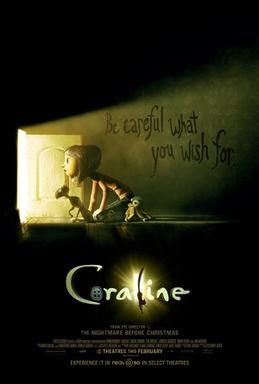
A stop-motion face has to change expression hundreds of times across a shoot without a computer touching the frame. Productions have converged on two competing answers to that problem, and the four films gathered here show both approaches at full scale, plus one film that runs them side by side. The first answer is mechanical: build the control into the puppet's head itself. Tim Burton and Mike Johnson's Corpse Bride (2005) is the widely cited turning point -- puppet heads carried internal clockwork mechanisms that let a single turn of a key drive a specific facial change, giving the animator fine, repeatable control an entirely soft, hand-manipulated face could not reproduce identically shot to shot. The second answer is replacement: build a library of pre-sculpted expressions and swap the whole face between frames instead of moving one. Henry Selick's Coraline (2009) relied on interchangeable, magnetised faces rather than an internal mechanism. LAIKA pushed the same idea further with 3D printing: Kubo and the Two Strings (2016) used 3D-printed replacement parts for its faces, and Missing Link (2019) scaled it to roughly 106,000 individual full-colour resin faces, registered to the puppet head by precisely machined magnetic mounts so thousands of swaps stay in alignment. LAIKA's Wildwood (2026) extends both traditions past the face entirely: 3D printing moved into armature and skeletal fabrication for more lifelike musculature, while its golden-eagle character The General combines fully articulated wings that open and collapse like a real bird's with a built-in mechanism that raises and lowers the puppet's chest to simulate breathing -- mechanical control and replacement fabrication solving one animal's whole body rather than just its face.